
How High School Math Can Help Students Earn the California State Seal of Civic Engagement
- Tammy Eggert
- May 26
- 4 min read

For many students, math class can sometimes feel disconnected from the real world. Equations, graphs, statistics, and formulas often seem isolated from the issues students care about in their communities. But across California, educators are beginning to discover something powerful: math can become one of the strongest tools for civic engagement.
Through intentional project-based learning and community-connected instruction, math classrooms can help students not only strengthen academic skills, but also qualify for one of California’s highest student recognitions: the California State Seal of Civic Engagement.
What Is the State Seal of Civic Engagement?
The California State Seal of Civic Engagement (SSCE) is an official recognition placed on a student’s diploma or transcript that honors their commitment to civic learning and community involvement.
The Seal recognizes students who demonstrate:
Understanding of civic issues
Community engagement and participation
Respect for diverse perspectives
Critical thinking and problem-solving
Civic responsibility and leadership
In simple terms, the State Seal tells colleges, employers, and scholarship organizations that a student has gone beyond academics and has actively worked to improve their community.
For students, this recognition can:
Strengthen college applications
Build leadership confidence
Develop communication and collaboration skills
Connect classroom learning to real-world impact
Help students discover purpose and career interests
Most importantly, it helps students understand that their voice matters.
Why Civic Education Belongs in Math Class
When people hear “civic education,” they often think of government or history classes. But civic engagement can happen in almost any subject — especially math.
Math naturally teaches students how to:
Analyze information
Interpret data
Identify patterns
Evaluate evidence
Make informed decisions
These are the exact skills communities need to solve real problems.
Today’s students are growing up in a world filled with statistics, graphs, polls, budgets, algorithms, and misinformation. If students cannot interpret data accurately, they struggle to fully participate in society.
Math classrooms can help students become informed citizens by teaching them how numbers influence:
Public policy
Environmental decisions
Housing and transportation
Public health
Voting trends
Economic inequality
Resource distribution
In other words, math helps students understand how communities function — and how they can improve them.
What Civic-Based Math Instruction Looks Like
Civic education in math does not mean turning math class into a political debate. Instead, it means connecting mathematical concepts to real community issues and allowing students to apply their learning in meaningful ways.
For example, an 11th-grade math class could explore:
Community traffic safety
Water conservation and drought
Public transportation access
School lunch waste statistics
Housing affordability trends
Mental health survey data
Local environmental concerns
Students might:
Collect and analyze data
Create graphs and predictive models
Conduct surveys
Compare statistical trends
Present findings to school or community leaders
Develop recommendations for improvement
Example: Using Polynomials to Address Community Issues
In an 11th-grade Algebra II class, students could use polynomial equations to study real-world community challenges.
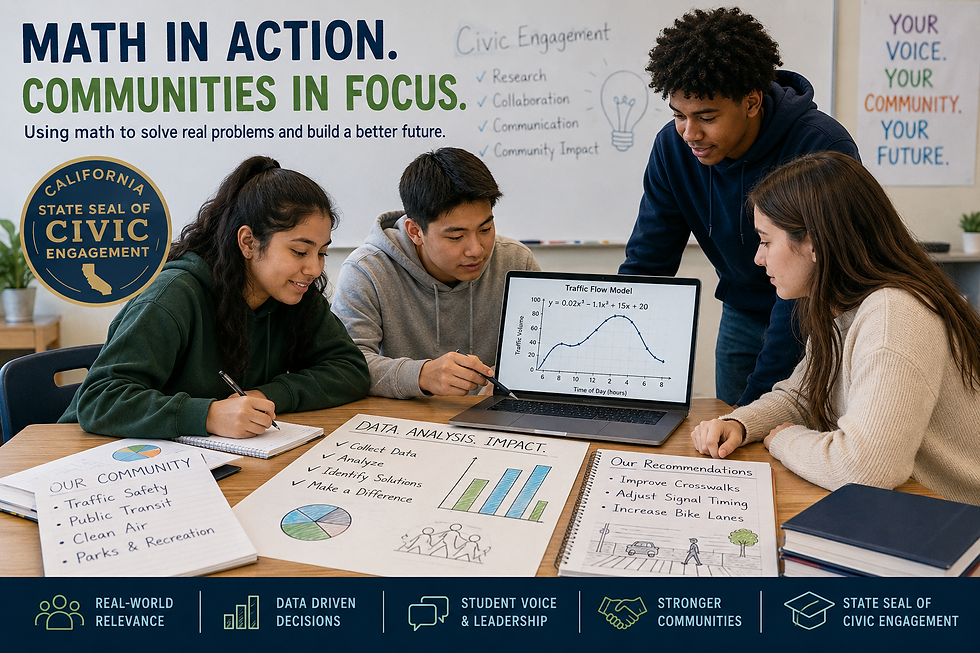
For example, students might investigate traffic flow and pedestrian safety near their school. Using data collected during different times of the day, students could create polynomial models that predict traffic congestion patterns or accident risk based on vehicle volume and speed.
Students could then:
Graph and analyze polynomial functions
Identify maximum and minimum points
Predict peak congestion times
Compare proposed safety solutions
Present recommendations to school officials or city planners
Through projects like these, students are not only practicing math standards — they are demonstrating civic engagement, collaboration, communication, and problem-solving.
These are key components of the State Seal of Civic Engagement.
Making Civic Education Easier for Math Teachers
One of the biggest concerns educators have is time. Teachers are already balancing standards, pacing guides, testing requirements, grading, and classroom management. Many love the idea of civic learning but worry it will require building an entirely new curriculum.
That is where the Civic Education Center can help.
The Civic Education Center works with schools and educators to make civic-based learning practical, flexible, and easy to integrate into existing classes. Rather than adding another program onto a teacher’s workload, the goal is to connect civic engagement naturally to what teachers are already teaching.
For math classrooms, that means helping educators turn existing lessons into meaningful real-world applications. A statistics unit can become a community survey project. Graphing lessons can analyze transportation or environmental data. Algebra can be tied to budgeting, resource allocation, or population trends.
The Civic Education Center provides:
Standards-aligned curriculum support
Civic project planning tools
Student workbooks and resources
Educator training and coaching
Guidance for State Seal alignment
Opportunities for student presentations and showcases
Most importantly, educators do not have to figure it all out alone. Schools can receive support in helping students document civic learning, reflect on their work, and align projects to State Seal expectations.
This allows teachers to focus on instruction while giving students meaningful opportunities to connect math to real community impact.
Why This Matters Right Now
Young people today are inheriting enormous challenges — misinformation, political division, economic uncertainty, environmental concerns, and rapid technological change.
Students need more than academic knowledge. They need opportunities to practice:
Critical thinking
Civil dialogue
Collaboration
Ethical decision-making
Community problem-solving
Math classrooms can become powerful spaces where students learn that numbers are not just abstract concepts — they are tools for understanding and improving the world around them.
When students begin using math to investigate real issues affecting their families and communities, learning becomes more relevant, engaging, and empowering.
When schools intentionally connect that work to the State Seal of Civic Engagement, students leave high school not only prepared for careers and college, but prepared for citizenship.
That may be one of the most important lessons schools can offer today.


Comments